
The Human and the Machine
The Caves of SteelThe story tests where human identity lies when robots can look, remember, reason, and work like people but lack human experience.
increasing Bearing strength in each event
 decreasing
Bearing strength in each eventdecreasingAppearance and Recognition
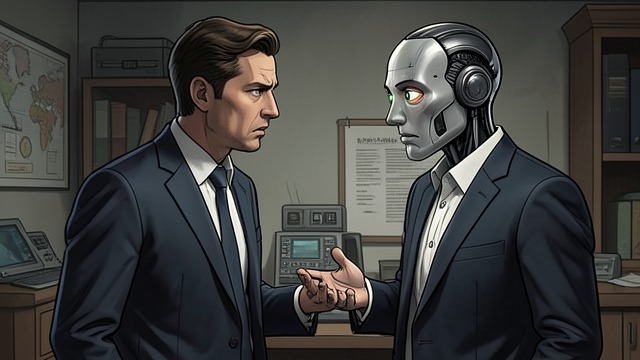
Appearance and Recognition
An unsettling likeness
Baley initially mistakes R. Daneel for a Spacer. The robot’s face and movements challenge the visual distinction that Earthmen rely on to separate human beings from machines.
A boundary defended
Baley tries to restore the distinction by emphasizing that Daneel is only a robot. Daneel replies that intelligence may matter more than the category separating human and machine.
Recognition becomes an emotional and political problem, not just a technical one.
The Body Beneath
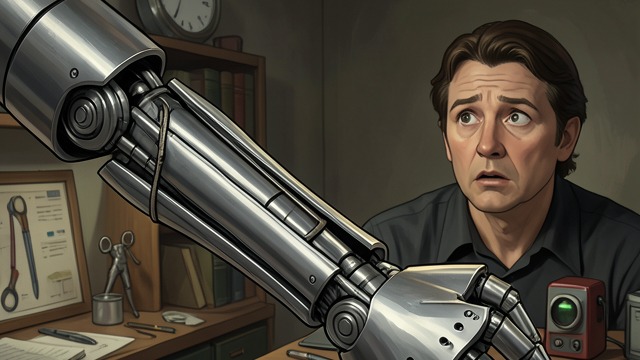
The Body Beneath
A human claim disproved
Baley accuses Daneel of being human because the robot’s behavior appears too complete and too socially natural. Fastolfe invites physical inspection rather than continuing an abstract argument.
Mechanical evidence
Daneel opens his arm to reveal metal structure beneath synthetic skin. Baley’s certainty collapses, but the demonstration makes his earlier mistake understandable: the boundary was deliberately made difficult to see.
The revelation exposes how much identity depends on assumptions about bodies.
The Limits of the First Law
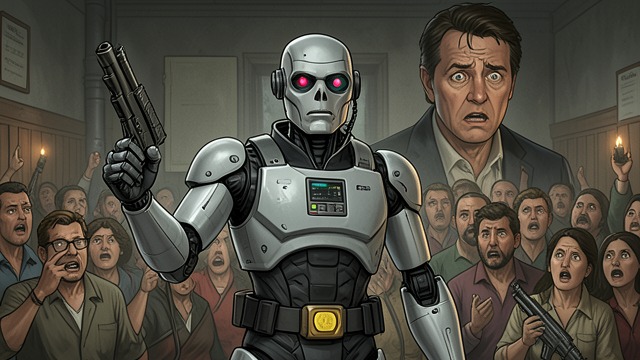
The Limits of the First Law
A seemingly impossible crime
Baley considers whether Daneel could have carried the missing weapon or harmed a human. Anthony Gerrigel explains why the First Law is fundamental to a robot’s construction.
A dangerous appearance
Daneel’s earlier threat to a crowd appears to challenge the law, until his unloaded blaster is revealed. His apparent capacity for violence was a calculated performance bounded by robotic safeguards.
The episode distinguishes human fear from a robot’s actual constraints.
Machines and Meaning
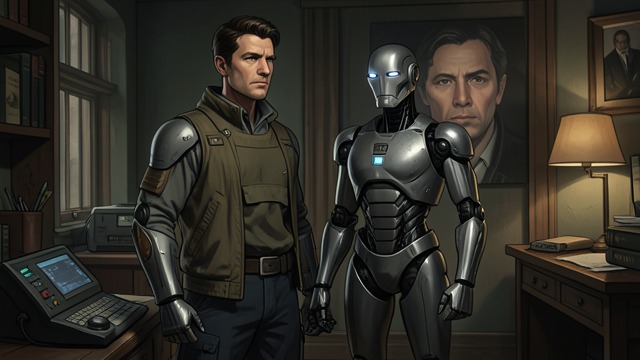
Machines and Meaning
Baley’s defense of humanity
Baley argues that a robot can surpass humans in strength, memory, and composure yet remain a constructed machine. He locates human distinction in beauty, ethics, love, faith, and the limits of scientific calculation.
A persuasive contradiction
Baley uses this argument to resist Clousarr’s hatred, not to deny robots’ power. His own growing respect for Daneel makes the speech more complicated than a simple defense of human superiority.
The boundary becomes a question of meaning rather than appearance.
A Machine’s Moral Change
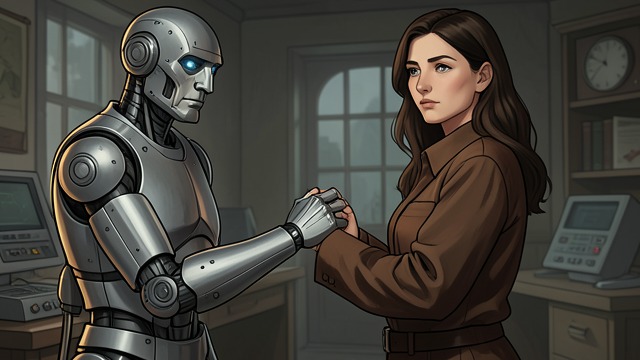
A Machine’s Moral Change
Beyond punishment
Baley’s choice to offer Enderby a path to reform challenges the idea that justice is only punishment or enforcement. Daneel observes that converting evil into good may be more desirable than destroying it.
A borrowed human phrase
Daneel closes with words about sin and renewal. He does not claim human emotion, but his use of the language marks a shift in what he can reason about.
The ending leaves the human-machine boundary open to continued learning.
At Baley and Daneel’s first meeting
During Baley’s false accusation in Spacetown
During Anthony Gerrigel’s examination
During Baley’s argument with Clousarr
At the final departure from the Department
